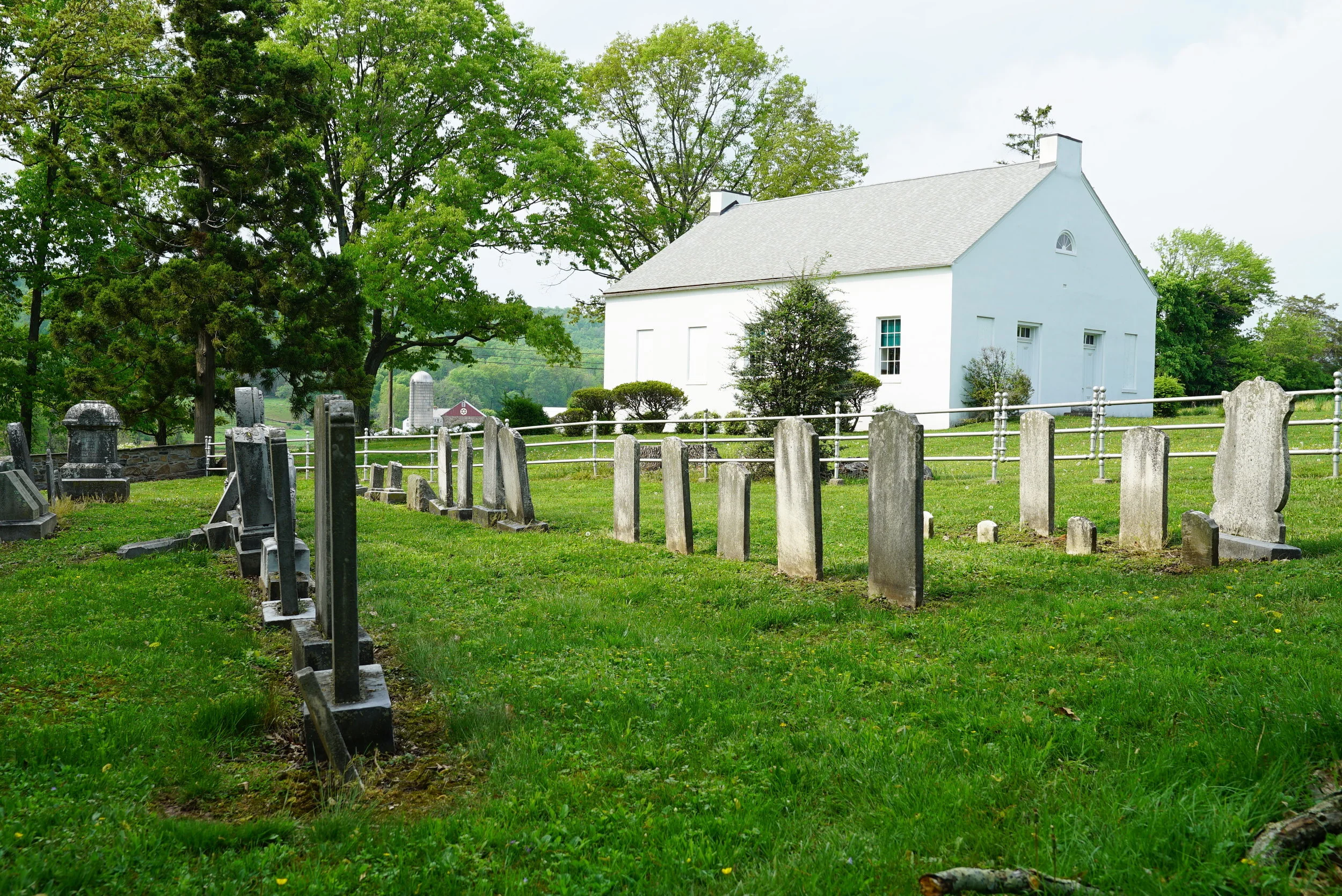
Kraussdale Meetinghouse
The story of the Kraussdale Meetinghouse begins with the life of Anna (Heydrick) Krauss. Anna Krauss, born about 1675, and her husband, Melchior Krauss, left Silesia in 1726 with their children and settled in Herrnhut, Germany. On April 19, 1733 they embarked on the long journey to Pennsylvania, but a month later, Melchior died in Haarlem in The Netherlands. Widow Anna and her five children continued on their journey to Pennsylvania, along with two other Schwenkfelder families, arriving in Philadelphia on September 28, 1733. Her eldest son, Balthasar Krauss, married Susanna Hoffman, and they lived on a farm near Kraussdale. Anna resided here with her son’s family. Burials at the Krauss farm had taken place for many years before any buildings were erected for worship and education. Anna Krauss was buried at Kraussdale in 1755. The land was passed down to Balthasar’s son, Balthasar, Jr., and then to Balthasar, Jr.’s youngest son, George, with the following stipulation: “Except one acre of land which shall belong to the graveyard (including the same) for a meeting house, if ever Schwenkfeldians shall intend to build one there, which said graveyard and one acre of land shall be free for the use of the said Schwenkfeldians with free Ingress, Egress, and Regress to and from the same forever.” In other words, his stipulation was that the cemetery continue to be accessible to the Schwenkfelders, and the land around it be available to them for the building of a meeting house. In accordance with this, George Krauss conveyed the acre of land to the trustees for the Society of Schwenkfelders. Over time, several parcels of land were added to this property.
There is some question as to the year when the first Kraussdale Meetinghouse was built, 1815 or 1825. In 1813, John Krauss, eldest son of Balthasar, Jr., wrote a vigorous petition praying the Schwenkfelders to erect a meeting house on this ground, particularly because of the frequent use of the burial ground, where many Schwenkfelders already had been laid to rest.
The first meeting house was a rough stone building with the joints painted white. This building was used for both school purposes and divine worship, and served for fifty years, until it was replaced with a brick structure. In 1900, the building was remodeled, and later, the brick was covered with white stucco. The first Christian Endeavor Society of the Schwenkfelder Upper District was organized in the Kraussdale Meetinghouse in 1894, with Elmer E. S. Johnson as president. 3 Regular worship services were discontinued here when the Palm Schwenkfelder Church was dedicated in 1911. As part of the Bi-Centennial celebration of 1934, monuments were erected at each burial ground known to hold the remains of Schwenkfelder immigrants. In front of each grave site was placed a small stone marker, engraved with his or her immigrant number, as assigned by the authors of The Genealogical Record of the Schwenkfelder Families, published in 1923. A series of memorial services was held, including unveiling the monuments, reading of brief biographical sketches, and decorating of the individual immigrant graves with flowers. There are a total of eleven Schwenkfelder immigrants buried here, as the large granite monument indicates. There is a unique variety of unusual trees on the meeting house grounds, planted in the early 1900's under the direction of Elmer K. Schultz, an amateur horticulturalist. He is buried in the mausoleum on the Palm Schwenkfelder Church Cemetery.